Facts checked Article
Game mechanics words
Can casinos adjust the RTP on slot machines? The RNG, and the game rules it is confused with
Not on an online slot while it is open for play in Great Britain. The RTP is set by the game rules, not the random number generator, and RTS 7D bars changing them while a game is available.
Can casinos adjust the RTP on slot machines? The short answer
Can casinos adjust the RTP on slot machines? Not on an online slot while it is open for play in Great Britain. The Gambling Commission’s rule RTS 7D says a game’s rules, payouts and outcome probabilities may not be changed while it is available, except as its own rules provide.
The RTP (return to player) is the share of stakes a game is designed to pay back over a very large number of plays. It does not sit in the random number generator (RNG) at all. It comes from the game rules: the paytable, the symbols on each reel and the feature rules.
So this entry defines the RNG first, then the neighbour it is most often confused with.
Sources: Gambling Commission: RTS 7; Gambling Commission: testing strategy Annex A.
1. Random number generator (RNG)
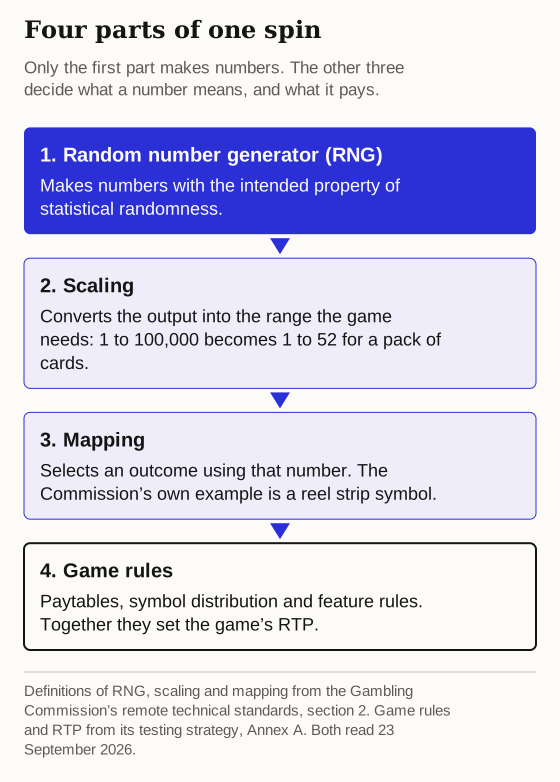
A random number generator is ‘any item of hardware or software which is used to generate random numbers with the intended property of statistical randomness’. That is the Commission’s definition, in section 2 of its remote technical standards.
Two more steps sit between the number and the screen. First, scaling converts the output into the range a game needs, such as 1 to 52 for a pack of cards.
Then mapping selects an outcome using that result. The Commission’s own example is a reel strip symbol.
Sources: Gambling Commission: RTS definitions.
Three words from one glossary
- Random number generator (RNG)
- Any item of hardware or software used to generate random numbers with the intended property of statistical randomness.Gambling Commission: RTS definitions · as checked on
- Scaling
- Converts the output from an RNG into the format a product needs: an output of one to 100,000 scaled to 1 to 52 for a standard pack of cards.Gambling Commission: RTS definitions · as checked on
- Mapping
- Selects an outcome using the result from an RNG. The Commission’s example: the result is mapped to a reel strip symbol.Gambling Commission: RTS definitions · as checked on
Definitions from section 2 of the Gambling Commission’s remote gambling and software technical standards, read on 23 September 2026.
2. Not to be confused with: the game rules that set the RTP
The game rules are the paytable, the symbol distribution and the feature rules. The Commission’s testing strategy says that ‘collectively the game rules determine the overall game RTP’. The RNG only supplies the numbers those rules read.
The Commission’s own worked example shows the split. A fruit machine has three reels of 20 positions, so there are 8,000 combinations.
At 50p a game, one pass through all 8,000 costs £4,000. It pays £3,600 in prizes, so the RTP is 90%.
Now put a third cherry on reel 3 in place of one blank. The cherry prizes rise from £160 to £240, so total prizes become £3,680 and the RTP becomes 92%.
The RNG did not change. The reel strip did.
Sources: Gambling Commission: testing strategy Annex A; Gambling Commission: how machines meet their %RTP.
Same RNG, two reel strips
| Line of the sum | Two cherries on reel 3 | Three cherries on reel 3 | Evidence |
|---|---|---|---|
| Cherry combinations in 8,000 | 8 | 12 | · Gambling Commission: how machines meet their %RTP |
| Cherry prizes at £20 each | £160 | £240 | · Gambling Commission: how machines meet their %RTP |
| All prizes paid | £3,600 | £3,680 | · Gambling Commission: how machines meet their %RTP |
| Cost of play, 8,000 games at 50p | £4,000 | £4,000 | · Gambling Commission: how machines meet their %RTP |
| RTP (prizes ÷ cost of play) | 90% | 92% | · Gambling Commission: how machines meet their %RTP |
One symbol moved on one reel. Nothing in the random number generator was touched.
3. Can the RTP change while a game is open?
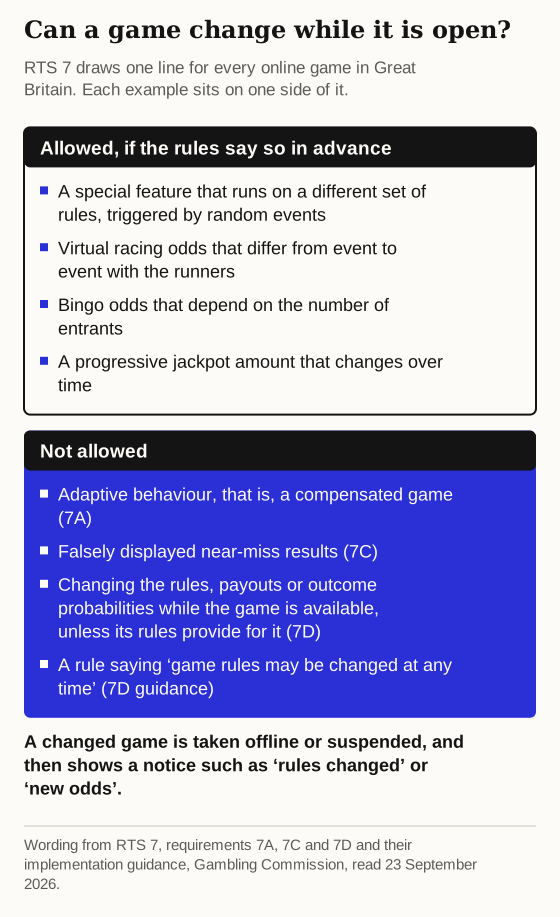
For online games, RTS 7 sets two limits. Requirement 7A says ‘adaptive behaviour (that is, a compensated game) is not permitted’. Requirement 7D bars changes to the rules, payouts and outcome probabilities while a game is available, unless the rules provide for them.
A change is made with the game taken offline or suspended. The altered game then shows a notice, such as ‘rules changed’ or ‘new odds’.
But some movement is written into the rules and is allowed. A progressive jackpot, one that grows from a share of stakes, may rise, and bingo odds may depend on the number of players.
Sources: Gambling Commission: RTS 7.
The rule, in the Commission’s words
The rules, payouts and outcome probabilities of a virtual event or game may not be changed while it is available for gambling, except as provided for in the rules of the game, lottery or virtual event. Such changes must be brought to customer’s attention.
4. Not to be confused with: a compensated machine
A compensated machine is a land-based gaming machine that adjusts as it goes. The Commission’s player guide says these machines ‘vary the chance of winning a prize depending upon results from previous games played’. On a random machine, the odds ‘remain constant’.
This is the one case where a game steers towards its figure. But it steers to meet its stated RTP, not to change it.
Online, RTS 7A rules it out. A gaming machine must also say whether it is compensated or random.
Sources: Gambling Commission: return to player; Gambling Commission: how machines meet their %RTP; Gambling Commission: RTS 7.
5. Who checks a change, and when
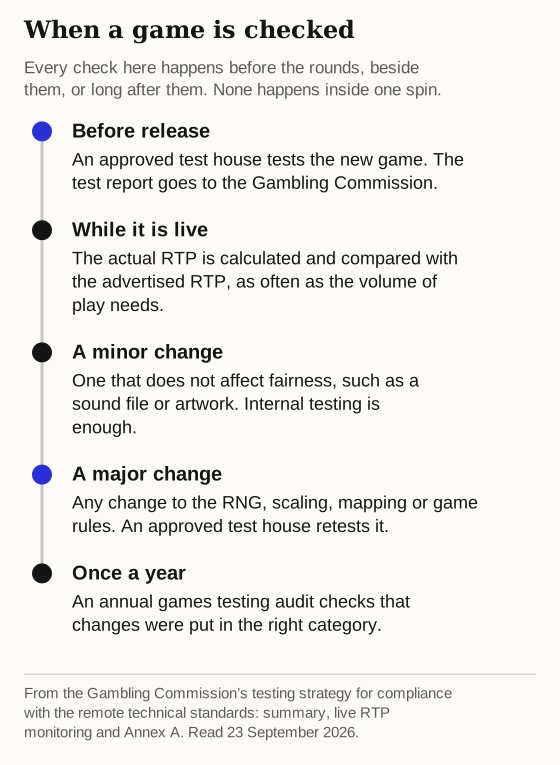
Every new online game is tested by an approved test house before release. The test report goes to the Commission. A major change needs external retesting, and the Commission counts ‘any change to the RNG, scaling and mapping, or game rules’ as one.
While a game is live, the licensee must monitor its actual RTP against the advertised figure. The Commission gives the sum as win divided by turnover, the total staked. An annual games testing audit then checks that changes were put in the right category.
Sources: Gambling Commission: testing strategy summary; Gambling Commission: testing strategy Annex A; Gambling Commission: live RTP monitoring.
6. In a game’s information screen
RTS 3C requires information about the chances of winning to be easily available before a customer commits to gamble. It must include the RTP percentage or the probability of winning events. That figure is the one the tests and the monitoring are measured against.
A word such as ‘random’ or ‘tested’ on that screen names a mechanism. So ask which mechanism and which evidence the claim refers to.
It is not an assurance about withdrawals, customer support or every product the operator supplies. A precise definition narrows the question; it does not certify the service.
Sources: Gambling Commission: RTS 3.
How to read a slot’s RTP claim
Four steps, in order, then what the result means. Each one rests on a Gambling Commission page read on 23 September 2026.
Open the game’s help or information page first
RTS 3C requires the chances-of-winning information to be easily available before a customer commits to gamble.
Copy the RTP figure and the date
Write down the percentage exactly as shown, with the date it was read. That is the advertised figure the operator’s monitoring is measured against.
Check what the rules allow to move
A progressive jackpot, a feature round or bingo odds may change within the rules. Anything else is fixed while the game is available.
Look for a change notice
An altered game should show a notice such as ‘rules changed’ or ‘new odds’. If one appears, read the figure again.
What the result means
The figure is an average over a very large number of plays. The Commission’s player guide says it is not what a session returns.
7. Usage note
In ordinary speech, ‘the RNG’ often stands for the whole game. In this entry it means the number source only. The RTP belongs to the rules.
Example: A £10 stake at 92% RTP has an expected return of £9.20 over a very large number of plays; one session can land far from that. Support: GamCare, 0808 8020 133.
Sources: Gambling Commission: return to player; GamCare: talk to us now.
Before trusting an RTP figure
Each line restates this entry. Ticks stay in the browser and are not sent anywhere.
- A claim that a game is random is not read as a claim about the operator’s service.
Ticks are kept only in this browser and are never sent anywhere.
Words used in this entry
- RTP (return to player)
- The share of stakes a game is designed to pay back over a very large number of plays, shown as a percentage. Set by the game rules.
- Progressive jackpot
- A prize that grows from a share of stakes until it is won. Its growth is written into the game rules.
- Turnover
- The total amount staked on a game. Actual RTP is win divided by turnover.
- Volatility and variance
- Measures of how widely results swing around the average. See the Casino Lexicon entry on game statistics words.
- Paytable
- The table in a game’s rules that says what each winning outcome pays. Part of the game rules, not the RNG.
- Compensated game
- A game whose software varies the chance or value of a win depending on recent results, to hold a target RTP. Not permitted online under RTS 7A.
- Major change
- A software change that may affect a game’s fairness. It needs external retesting by an approved test house.
- Approved test house
- A testing firm on the Gambling Commission’s published list, allowed to carry out third-party testing of games.
See also
For the percentage itself, see the entry on 99% RTP. For the words that travel with a game’s statistics, such as how widely results swing, see volatility and variance. For the long form of game testing, and for why a studio’s RTP range does not name the version in a casino, see Studio Ledger.
Sources read — checked 23 September 2026
Eight Gambling Commission pages and one GamCare page, each opened on 23 September 2026. Three are parts of the remote technical standards: the definitions, RTS 3 and RTS 7. Three are parts of the testing strategy: the summary, live RTP monitoring and Annex A.
The other two Commission pages are its player guide to return to player and its licensing-authority feature article on how gaming machines meet their RTP. The helpline number is from GamCare’s own contact page.
Sources: Gambling Commission: RTS definitions; Gambling Commission: RTS 3; Gambling Commission: RTS 7; Gambling Commission: testing strategy summary; Gambling Commission: live RTP monitoring; Gambling Commission: testing strategy Annex A; Gambling Commission: return to player; Gambling Commission: how machines meet their %RTP; GamCare: talk to us now.
Questions answered
Can casinos adjust the RTP on slot machines?
Not on an online slot while it is open for play in Great Britain. RTS 7D says rules, payouts and outcome probabilities may not be changed while a game is available, except as its own rules provide, and a changed game shows a notice such as ‘rules changed’.
Does the RNG decide the RTP?
No. The RNG makes numbers. The Commission’s testing strategy says the game rules, meaning pay tables, symbol distribution and feature rules, collectively determine the overall game RTP.
Can an online slot pay less after a run of wins?
Not in Great Britain. That would be adaptive behaviour, a compensated game, which RTS 7A does not permit for online games.
What is a compensated machine?
A land-based gaming machine whose software varies the chance of winning depending on results from previous games, to meet its stated RTP. The machine must say whether it is compensated or random.
Reference sources
- Remote gambling and software technical standards: 2 – Definition of terms
- RTS 7 – Generation of random outcomes
- RTS 3 – Rules, game descriptions and the likelihood of winning
- Testing strategy for compliance with remote gambling and software technical standards: summary
- Testing strategy: live RTP monitoring
- Testing strategy: Annex A – major and minor game and software updates
- Return to player: how much gaming machines payout
- LA Bulletin August 2020 – Feature article: How can gaming machines meet their %RTP if they are random?
- Talk to us now
Continue reading

Return is not the same as profit
Imagine an educational example with a £10 stake and an advertised settlement of £18 including that original stake.
Read Return is not the same as profit
Wagering, turnover and the other bonus words that need separating
Short paired definitions for promotion wording: the amount wagered, the requirement, the deadline, the qualifying game and the restriction are different fields.
Read Wagering, turnover and the other bonus words that need separating
Volatility, variance and the words around a game’s statistics
Eight short entries separate measures of spread, averages, returns and probabilities. Each definition stays brief and points to the appropriate longer explanation.
Read Volatility, variance and the words around a game’s statistics
What slot has 99% RTP?: definition, and the term it is confused with
99% RTP names a game designed to return 99% of what is staked as prizes over a very large number of plays. It is not a session figure and it is not a compensated game. The Gambling Commission's pages read on 21 September 2026 name no such slot, and this entry names none.
Read What slot has 99% RTP?: definition, and the term it is confused with
What your casino account messages mean: a decoder
Twelve interface phrases from casino accounts — pending, self-excluded, verification required, bonus balance and more — defined in under 300 words each, each pointing to the site that documents the rule behind it.
Read What your casino account messages mean: a decoder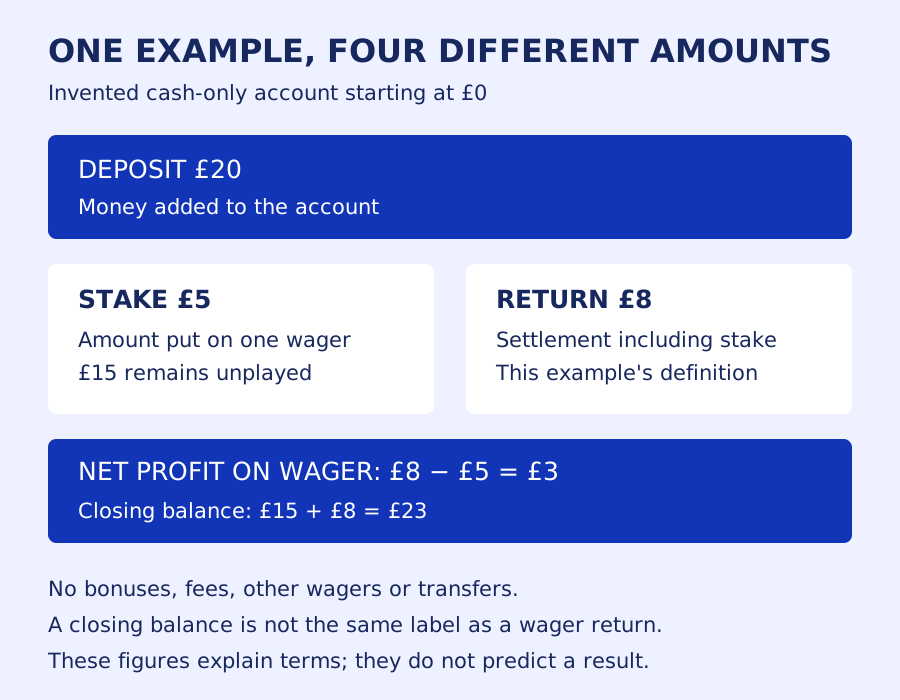
Online casino terms: a guide to commonly confused pairs
Clear distinctions between deposit and stake, return and profit, RTP and results, demo play and bonuses, with worked examples and a term selector.
Read Online casino terms: a guide to commonly confused pairs
Continue reading
What slot has 99% RTP?: definition, and the term it is confused with
99% RTP names a game designed to return 99% of what is staked as prizes over a very large number of plays. It is not a session figure and it is not a compensated game. The Gambling Commission's pages read on 21 September 2026 name no such slot, and this entry names none.
Read What slot has 99% RTP?: definition, and the term it is confused withWagering, turnover and the other bonus words that need separating
Short paired definitions for promotion wording: the amount wagered, the requirement, the deadline, the qualifying game and the restriction are different fields.
Read Wagering, turnover and the other bonus words that need separatingVolatility, variance and the words around a game’s statistics
Eight short entries separate measures of spread, averages, returns and probabilities. Each definition stays brief and points to the appropriate longer explanation.
Read Volatility, variance and the words around a game’s statisticsReturn is not the same as profit
What your casino account messages mean: a decoder
Wagering, turnover and the other bonus words that need separating
Online casino terms: a guide to commonly confused pairs
Volatility, variance and the words around a game’s statistics
What slot has 99% RTP?: definition, and the term it is confused with