
Casino terminology
Wagering, turnover and the other bonus words that need separating
Short paired definitions for promotion wording: the amount wagered, the requirement, the deadline, the qualifying game and the restriction are different fields.
Wagering requirement / turnover
A wagering requirement is a condition expressed as an amount that must be wagered before the relevant funds become withdrawable. Turnover, when used to describe betting activity, is the accumulated amount staked over the stated scope. One is a condition; the other is an activity total. Always check how the particular document defines its label.
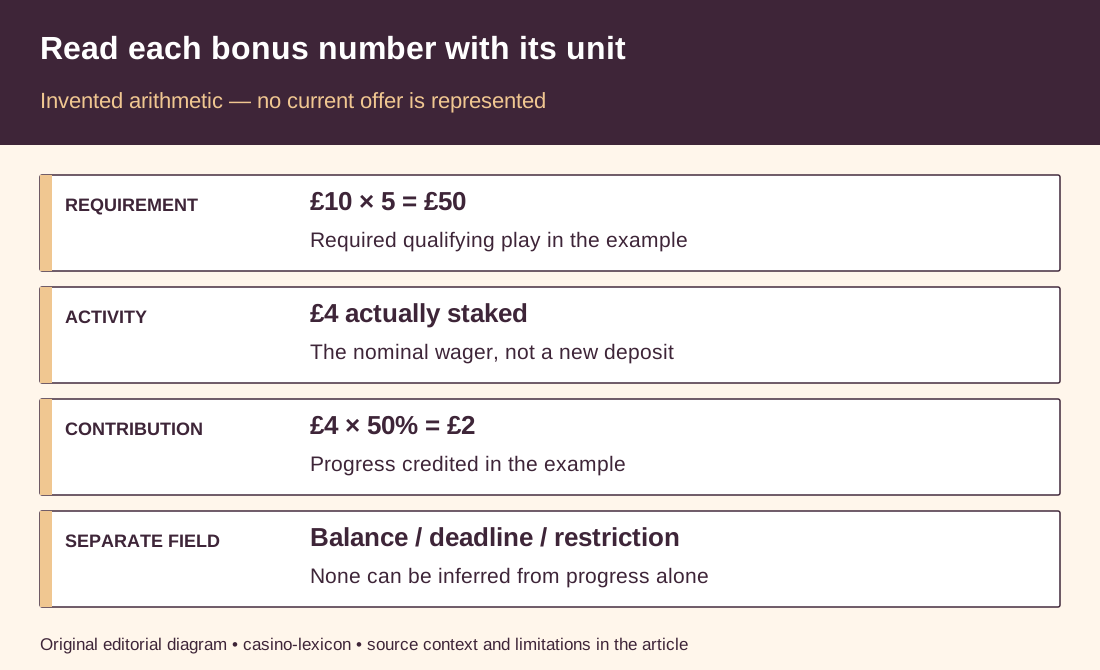
In an invented example, a £10 bonus with a five-times requirement produces a £50 requirement: £10 × 5. That is not a £50 deposit instruction, a £50 loss forecast or a promise that £50 will remain afterwards. The amount repeatedly put at risk and the amount left in an account are different quantities. Reusing the same money across several wagers can increase turnover without increasing the amount originally deposited.
The current Commission rewards code limits bonus wagering requirements to a maximum of ten times. That rule does not make every promotion suitable or remove its other conditions. This entry explains the words, not how to clear a bonus. For worked interpretation of the multiplier and its basis, use the full wagering-requirement explanation. No bonus in this article is an observed or recommended offer.
Sources: LCCP 5.1.1 Rewards and bonuses.
See also: StakeSource and retrieval date above
Qualifying action / wagering progress
A qualifying action is something the promotion says must happen for a benefit or stage to be earned. Wagering progress is the amount counted towards a wagering requirement. Accepting an offer, receiving its reward and completing its wagering conditions should not be silently treated as the same event.
Betfair's public promotion FAQ contains separate questions about completing an offer, receiving a credit and tracking a bonus. That separation is useful evidence of the questions a reader needs to ask. It is not evidence that every operator uses the same steps or the same screen labels. No logged-in promotion was inspected here.
For a hypothetical worksheet, use separate fields headed accepted, qualification confirmed and wagering progress. Fill each only from the relevant record. A visible progress percentage without a label does not tell you which stage it measures. If a reward is absent, identify the missing stage before assuming that more gambling is needed. The detailed promotion checklist belongs with the actual offer terms; this definition supplies only the distinction.
Sources: Casino Promotion - FAQs; Glossary of terms.
See also: Wagering requirementSource and retrieval date above
Eligible game / contribution rate
An eligible game is one included under the promotion's stated game conditions. A contribution rate describes how much qualifying play counts towards the wagering requirement. Being permitted to use a game does not, by the wording alone, establish that every pound staked counts as a full pound of progress.
Consider a synthetic £4 stake with a stated 50% contribution: the credited amount would be £4 × 0.5 = £2. The remaining £2 has not vanished from the stake or become a separate fee; the calculation describes the progress counter only. No actual game weighting or available promotion is asserted by these numbers.
The Commission's significant-terms guidance includes game restrictions and varying contributions among information that needs explaining. Betfair's FAQ also points readers to eligible games and warns that some stakes may not count in full. The useful next document is the specific game's contribution entry for that offer. The game-contribution explanation covers that reading task in depth. A game appearing in the casino lobby is not itself an offer-specific eligibility record.
Sources: Glossary of terms; Casino Promotion - FAQs.
See also: Stake · Wagering requirementSource and retrieval date above
Offer closing time / bonus expiry
An offer closing time tells you when the promotion or an entry step closes. A bonus expiry tells you how long the awarded benefit remains available under its terms. They can describe different clocks. Do not copy a countdown into your notes without recording what the countdown is attached to.
The distinction appears in Betfair's public help, which addresses completing an offer and the availability period of a bonus in separate sections. This article does not repeat the operator's default duration as a universal rule; the relevant promotion can state its own terms. A person reading another casino's page must use that casino's applicable document.
In an invented example, an offer accepts entries until Friday while an awarded bonus has a separately stated expiry. The example supplies no actual deadline. Its purpose is to show why the start event, time zone and thing expiring belong beside the time. If one of those is unclear, the deadline remains unclear. The detailed deadline checks explain how to read the actual condition without turning this short definition into a schedule or an instruction to play faster.
Sources: Casino Promotion - FAQs; Glossary of terms.
Source and retrieval date above
Maximum stake / wagering multiplier
A maximum stake is a restriction on the size of an individual bet in the stated context. A wagering multiplier scales the amount used to calculate a requirement. Both can be printed as small numbers near a bonus, but they answer different questions and have different units.
Suppose invented wording says a five-times requirement and a £2 maximum qualifying stake. Five is a multiplier; £2 is a per-bet amount. Neither value tells you whether a particular game contributes, how long the benefit lasts or what balance is withdrawable. Treat those as additional fields rather than trying to infer them from the most prominent number.
The Commission lists maximum stake size among examples of significant promotion conditions. The current cap on the wagering multiplier does not convert a promotion's maximum stake into ten times anything. These are separate restrictions. The stake and multiplier distinctions in the long-form terms article show where each belongs. No hypothetical stake here is a recommendation, and a short dictionary entry cannot confirm the fairness or enforceability of a particular operator's term.
Sources: Glossary of terms; LCCP 5.1.1 Rewards and bonuses.
Source and retrieval date above
Play restriction / accusation of cheating
A promotional play restriction describes conduct that an offer disallows. An accusation of fraud, collusion or deliberate cheating is a different assertion. Readers should not assume that breaching an offer-specific rule automatically establishes every more serious label that might appear in a response.
The Commission's guidance requires prohibited promotional play to be specified and separates those restrictions from terms concerning fraud, collusion and other technical abuse. It also addresses explanation of a decision to refuse winnings or withdrawal for a promotional restriction, subject to wider regulatory obligations. The distinction is about the stated basis of the decision, not a finding about any reader's behaviour.
When reading a message, identify the actual clause and the conduct it is said to cover. Preserve the wording; do not replace it with a stronger accusation in your own notes. If the message supplies only a general label, the specific basis remains an unanswered question. Reviewing promotional restrictions is the longer task. This entry neither offers a way around a restriction nor decides whether a particular refusal is correct.
Sources: Promotional play restrictions.
See also: WithdrawalSource and retrieval date above
Leaving a promotion / withdrawing your own money
Leaving a promotion concerns participation in the offer. Withdrawing your own deposit balance concerns access to your money. The consequences for restricted bonus funds must not be treated as an automatic description of the treatment of deposit funds. The relevant balance and applicable obligations matter.
The Commission's guidance says customers must be able to withdraw their deposit balance while a bonus is pending or active, subject to general regulatory obligations. It also discusses fair, transparent processing-fee and partial-withdrawal qualifications. This does not mean every payment must arrive instantly, or that every verification request is prohibited.
The CMA's guidance supports distinguishing customers' money from bonus funds. Its publication page now also explains that the unfair-commercial-practices legislation changed in April 2025, so an old legal label should not be presented as if nothing changed. For actual offer wording, use the deposit-withdrawal distinction in the detailed terms coverage. If an operator's generic help appears inconsistent with the applicable terms or official guidance, preserve the discrepancy instead of treating the generic wording as the final answer.
Sources: Restrictions on withdrawing deposit and deposit winnings; Online gambling promotions: do’s and don’ts for online gambling firms; Online gambling promotions: consumer law guidelines.
See also: WithdrawalSource and retrieval date above
Significant terms / the complete terms
Significant terms are the important restrictions a reader needs to understand about an offer, such as eligibility, timing, qualification and limits. The complete terms are the fuller document in which those conditions and their detail are set out. A short headline cannot answer every detailed question, but its brevity is not a reason to hide a material restriction.
Use a two-column note: the summary wording you saw and the detailed clause you found. If the summary says that some games are excluded, keep the location of the actual list. If it gives a multiplier, keep the amount to which the multiplier applies. This is a reading aid, not a judgment that the advertisement satisfies every applicable rule.
The comparison below keeps the eight entries' central distinction visible through a single invented example. Read each figure with its unit and scope. Do not combine £50 of required play, £4 staked and £2 credited into one supposed account balance. The full terms-reading method owns the longer analysis; this collection ends once the words can be placed in the right fields.
Sources: Glossary of terms; Online gambling promotions: do’s and don’ts for online gambling firms.
See also: StakeSource and retrieval date above
| Example wording | Meaning in this example | Not the same as |
|---|---|---|
| £10 bonus × 5 | £50 required qualifying play | A £50 deposit or predicted loss |
| £4 stake, 50% contribution | £2 credited towards the requirement | The account balance after the bet |
| £2 maximum stake | An illustrative per-bet restriction | The five-times multiplier |
| Offer closes / bonus expires | Separate labelled deadline fields | One universal expiry date |
Questions answered
What are wagering requirements?
They specify an amount of wagering required before the relevant funds become withdrawable. Record the amount or multiplier and its basis, rather than treating it as a deposit instruction.
How long is my bonus available for?
Check the specific benefit’s expiry and the event that starts its clock. The promotion’s closing time is not necessarily the same field.
Which games count towards a bonus?
Use the offer-specific eligibility list and any contribution information. Availability in a casino lobby does not establish eligibility for a particular bonus.
Where is bonus progress recorded?
Identify the progress field and what it measures in the operator’s account or offer documentation. Keep qualification, wagering progress and remaining balance separate.
What could explain a missing promotion credit?
Check the stated qualification and crediting conditions against the actual account record. This dictionary cannot determine a personal account outcome or tell you that more gambling will fix it.