Core guide
What your casino account messages mean: a decoder
Twelve status words that appear on a casino account screen — not marketing copy, not game rules — defined in under 300 words each. Every entry points to the sibling publication that documents the rule behind the word.
How this index was built
Every entry below is a word or short phrase that appears in a live casino account interface — a withdrawal screen, a limits page, an account-status banner — rather than in marketing copy or a game's help file. The selection method is narrow on purpose: a phrase qualifies only if it is something a reader could actually see on screen and not immediately know the scope of. Twelve phrases met that test clearly enough to write about without inventing an account to screenshot.
Each entry does three things in order: states what the word covers, states what it does not cover, and names the sibling publication that documents the rule generating that word. That publication, not this one, holds the timescales, thresholds and conditions — this page only decodes the label. Where a definition rests on a specific rule or figure, the rule is quoted from a primary source with the date it was checked.
The entries are grouped loosely by where they appear in an account's life: identity and access first, then money and bonuses, then game and prize labels, then live-format language. The grouping is for navigation only; none of these words requires the others to make sense, and a reader can start anywhere in the list.
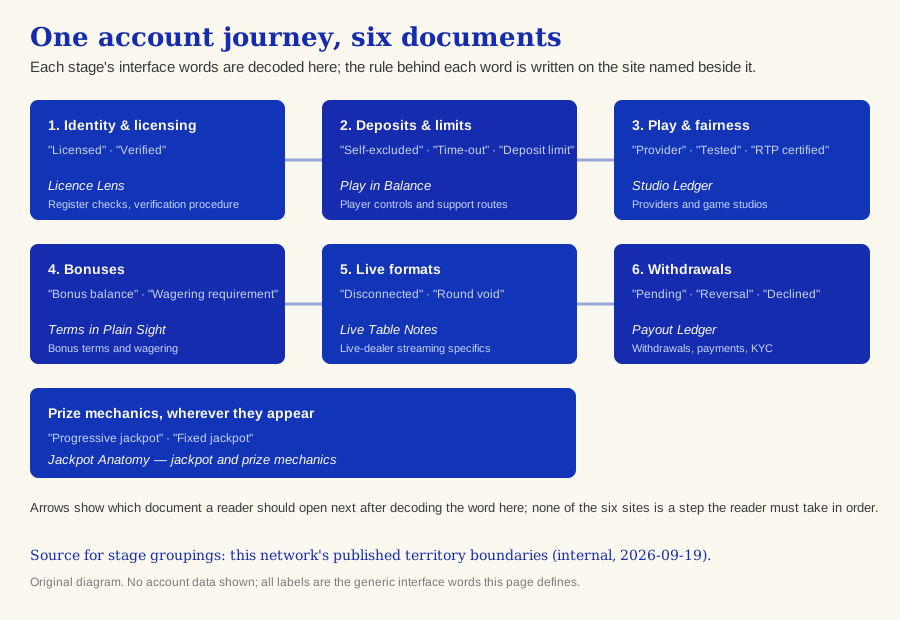
Pending / declined: a withdrawal request's status, not its balance
"Pending" means an operator has recorded a withdrawal request and has not yet released the funds. It says nothing about why: a request can sit as pending while a routine check runs, while a payment method is confirmed, or simply while a queue clears. "Declined" means that specific request failed — a card was invalid, a limit was exceeded, a check was not completed in time. Declined does not mean the account is closed, and it does not mean the money behind the request has been forfeited; it means that one attempt to move it did not succeed.
Treat the two words as describing the request, not the account. An invented illustration: an account log shows "£120 requested, Pending" for two days, then "Declined — verification incomplete." The £120 has not vanished; it remains in the account's balance until a further transaction — a new withdrawal attempt, a refund, or an adjustment — changes that figure. Reading "declined" as "lost" is the most common misreading of this pair, and it usually sends someone looking in the wrong place for an answer.
Neither word documents what a specific check involves, how long an operator is entitled to take, or what recourse exists if a request stalls. That is the withdrawal-and-payments territory this index does not attempt to cover. Payout Ledger documents the withdrawal journey, the identity and source-of-funds checks that can sit behind a pending status, and the payment methods involved — read it for the process; this entry only names the word on the screen.
Verification required / verified: an identity check, not a licence check
On an individual account, "verification required" means the operator needs documents or data to confirm who the account holder is — proof of identity, address or, for some accounts, source of funds — before certain actions, usually a first withdrawal, proceed. "Verified" means that specific check has been completed for that account. Both words describe a relationship between one operator and one customer. Neither says anything about whether the operator itself holds a gambling licence, which is a separate question about the business rather than the individual.
The confusion runs in a specific direction: a reader who has been asked to verify their identity sometimes assumes this is unusual or a sign something is wrong with the operator. It is a standard step, not a flag. What varies between operators is which documents are requested, when in the account's life they are requested, and how the request is worded — none of which this entry documents, because doing so would mean writing the long-form withdrawal and identity-check guide that belongs elsewhere.
For the account-side process — what identity verification typically involves and how it sits inside a withdrawal — see Payout Ledger. For the separate, business-side question of whether an operator is licensed at all, see the "Licensed / verified" entry further down this page, which points to Licence Lens.
Reversal / cancellation: undoing a payout before it leaves
A "reversal" moves a withdrawal request back into an account's playable balance after it was submitted but before the funds left the operator. Some operators offer this as a button a customer can press; others reverse a request automatically under specific conditions stated in their own terms. Either way, a reversal is a customer- or system-initiated undo, not a bank or payment-provider event — once money has actually left the operator's systems, "reversal" is no longer the applicable word, and a different process, outside this account, applies.
"Cancellation" is often used interchangeably with reversal in casino interfaces, though some operators reserve it for a request stopped by the operator rather than the customer. Because the two words are not applied consistently across operators, the safest reading practice is to check the specific screen's wording against that operator's own definitions page or terms, rather than assuming one company's usage of "reversal" matches another's.
This pair sits squarely inside the withdrawal journey, alongside "pending" and "declined" above. It is not a game-rules term and it does not describe anything about a bet's outcome. Payout Ledger is the sibling publication that documents withdrawal mechanics, including where a reversal option is likely to sit in that journey and what is typically required to use it.
Self-excluded / timed out: two different account locks
Both phrases describe a customer choosing to block their own access, but they are not the same tool. GAMSTOP, the UK's multi-operator self-exclusion scheme, states that registering means a person "will be prevented from using any gambling websites and apps run by gambling businesses licensed in Great Britain, for a period of your choosing" — a lock the customer sets and that applies across participating operators at once, not to a single account.1 A time-out, by contrast, is a shorter, single-operator break: the Gambling Commission's own guidance describes it as a way to "block yourself from gambling for up to six weeks" on that operator.2
The practical difference that matters to a reader: a time-out is short, operator-specific and designed to lapse; self-exclusion through a scheme like GAMSTOP is longer, spans multiple operators at once, and is not intended to be reversed on request during the chosen period. An account marked "timed out" for two weeks and an account marked "self-excluded" are not on the same footing, even though both stop a person from placing a bet on that screen.
Neither term documents the removal process, the exact minimum periods a specific scheme enforces, or what support sits alongside either tool. Play in Balance owns player controls and support routes in full, including these two tools and how they interact with an account.
Sources: 1. Gambling Commission: free multi-operator and national self-exclusion schemes, accessed 19 September 2026. 2. Gambling Commission: give yourself timeouts from gambling, accessed 19 September 2026.
Deposit limit / loss limit: what each cap restricts
A deposit limit caps how much money can be added to an account within a stated period. A loss limit, where an operator offers one, caps how much can be lost — meaning the limit tracks the difference between stakes and returns, not the amount paid in. An account can hit a deposit limit while still winning overall, and it can lose steadily for a long time without ever reaching a deposit limit, because the two figures measure different things.
UK operators are required to let customers set their own financial limits from the start of the account relationship: Gambling Commission requirements state that "customers must be prompted to set a limit as part of the registration process or at the point at which the customer makes the first deposit," presented through a free-text entry rather than a fixed menu of amounts, with a change able to take effect "as soon as practicable" after the request — a requirement that came into force on 31 October 2025.1 That requirement concerns deposit limits specifically; it does not itself specify a loss-limit mechanism, which is a narrower tool not every operator offers in the same form.
Reading an account screen, check which word is printed rather than assuming the two are interchangeable: a "limit reached" banner next to a deposit box is not describing the same restriction as one next to a loss tracker. Play in Balance documents player-set controls in full.
Source: 1. Gambling Commission: proposals 1a and 1b, enabling consumers to determine their own limits, accessed 19 September 2026.
Bonus balance / deposit balance: which one carries the wagering requirement
A deposit balance is a customer's own money. A bonus balance is promotional funds credited under an offer's stated conditions. The distinction matters because a wagering requirement — a condition specifying how much must be wagered before funds become withdrawable — can lawfully attach to a bonus balance, but Gambling Commission guidance is explicit that it cannot be used to block access to a deposit balance: operators must let a customer withdraw their deposit balance "at any time, including when a bonus is pending or active on the account," and wagering conditions may only apply to bonus winnings, not to a customer's own deposited money.1
That guidance also requires the two balances to be shown separately and prominently, and bans specific phrasings the Commission has identified as misleading — such as tying a deposit withdrawal to a multiple of the original stake.1 In practice, this means an account showing "Deposit balance: £40, Bonus balance: £15" is telling a reader something functional, not decorative: the £40 should be withdrawable on request regardless of what the £15 requires.
This entry defines the balance types and the withdrawal principle; it does not reproduce or interpret any specific promotion's wording. Terms in Plain Sight owns bonus terms and wagering in full, including how to read a specific offer's conditions.
Source: 1. Gambling Commission: restrictions on withdrawing deposit and deposit winnings, accessed 19 September 2026.
Licensed / verified: a register entry, not an account check
"Licensed" describes a business: the Gambling Commission maintains a public register of gambling businesses, searchable "by business name, trading name, domain name or account number," which a reader can use to confirm whether a given operator holds a British licence at all.1 Commission guidance on what to check before gambling with an operator tells readers to confirm the business holds a licence, to check that licence against the public register, and to verify that "the details of the licence (including activities and website domain names) match the public register."2 That is a business-level, one-time-per-operator check.
"Verified," used on an individual account, is the identity check covered earlier in this index — a relationship between one customer and one operator, unrelated to whether that operator's licence itself is genuine. A verified account can exist on an unlicensed site if a reader has not separately checked the register; a licensed operator can still require a customer to complete identity verification before a withdrawal proceeds. The two checks answer different questions and neither substitutes for the other.
This entry states the distinction; it does not walk through the register search step by step. Licence Lens owns licence-verification procedure in full, register by register.
Sources: 1. Gambling Commission: full register of gambling businesses, accessed 19 September 2026. 2. Gambling Commission: what to look at before you gamble, accessed 19 September 2026.
Restricted in your region / not available in your country: an access message, not an account lock
This message means an operator, a specific game, or a specific promotion is not being offered to an account associated with a particular location — a decision the operator or the game's provider has made about where it will do business, not something the customer did to their own account. It is a different category of restriction from a self-exclusion or time-out, which the customer chooses, or a verification hold, which is about proving identity. Regional restriction is about jurisdiction: which regulator's rules apply, and whether the operator or provider has chosen to trade under them at all.
An invented but representative case: two accounts registered from different addresses might see a different game list from the same operator, with one showing a title the other cannot open, labelled "not available in your region." Neither account is faulty; the two locations sit under different rules or different commercial decisions by the provider, and the label is simply reporting that fact at the point of play.
This index does not attempt to explain which jurisdictions govern what, how market entry and exit work, or how a specific country's rules differ from Great Britain's. Night Atlas owns regulatory geography and jurisdictional comparison in full — the right next stop for a reader who wants to know why the message appeared, not just what it means.
Tested by an approved test house / certified fair: a pre-release process, not a per-spin guarantee
Gambling Commission testing strategy requires that licensees "must ensure that all new products have been adequately tested by an approved test house prior to release and evidence of this (test report) has been supplied to the Gambling Commission," a requirement that applies in particular to the fairness of RNG-driven products such as casino, bingo and virtual-betting games.1 The Commission also distinguishes major changes to a game, which require external retesting by an approved house, from minor changes, which can rely on internal testing subject to an annual audit.1 "Tested" or "certified fair," seen on a game's information screen, is referring to this pre-release and change-control process.
What it is not saying is that every individual spin, hand or round has been separately checked at the moment it happens. The testing regime verifies the software and its rules before and as they change; it does not re-verify each outcome live. A reader who wants a claim about what "random" and "fair" cover at the level of the actual number generation, rather than the testing process around it, needs the mechanics, not this label.
The testing-house system itself, and how a specific provider's products pass through it, sits with Studio Ledger, which owns game providers and studios. This entry only decodes the phrase.
Source: 1. Gambling Commission: testing strategy for compliance with remote gambling and software technical standards, summary, accessed 19 September 2026.
Provider / operator: the studio behind the game, the business behind the account
A "provider" builds and supplies a game or the underlying gambling software; an "operator" is the business running the gambling website or app a customer holds an account with. Gambling Commission guidance on software separates the permission to manufacture, supply, install or adapt gambling software from the separate permission to provide gambling facilities to customers — two different licensable activities that are not automatically held by the same company.1 A game's loading screen naming a studio, and an account's terms page naming the operator, can legitimately name two different businesses, and evidence about one does not transfer to the other.
This distinction affects where a complaint or a question belongs. A question about a specific slot's mechanics, its RTP figure or its testing history is a provider-side question; a question about a withdrawal, a bonus term or a licence is an operator-side question, even when both appear inside the same branded interface. Reading the small print at the foot of a game window, rather than the operator's own branding at the top of the page, is usually the fastest way to identify which is which.
Provider and operator roles, and how to trace a specific game to its studio, are covered by Studio Ledger. The operator side of licensing sits with Licence Lens.
Source: 1. Gambling Commission: what is gambling software?, accessed 14 September 2026.
Progressive / fixed jackpot: how a prize grows, not how likely it is
A progressive jackpot accumulates contributions taken from stakes above a starting value, so its displayed figure rises as it is played. A fixed prize instead pays an amount, or follows a payout rule, set for the stated game conditions — "fixed" does not necessarily mean identical at every stake level, only that it is not accumulating the way a progressive figure does. Gambling Commission technical standards for progressive jackpot systems identify information such as how a jackpot is funded, who is eligible for it, and how an award is actually determined as the relevant detail behind any such prize.1 Neither word — progressive or fixed — states the chance of winning it.
A rising number on a banner is evidence that a progressive mechanism exists and is being fed by play; it is not evidence of how the trigger works, how often it fires, or what proportion of a game's stakes feed it. Those questions require the specific game's documentation, not the label on the banner.
This entry only distinguishes the two prize types as words. Jackpot Anatomy owns jackpot and prize mechanics in full, including funding, eligibility and how awards are actually determined for specific jackpot systems.
Source: 1. Gambling Commission: RTS 9, progressive jackpot systems, accessed 14 September 2026.
Round disconnected / round voided: interruption language, live and RNG play alike
"Disconnected" describes a break in the connection between a customer and a round in progress — most visibly in live-dealer play, where a stream or a betting window can drop mid-round, but the word also appears in some RNG-driven interfaces after a network interruption. "Voided" describes a different outcome: the round itself is cancelled and, typically, stakes are returned, usually because a malfunction or an error in that specific round means its result cannot stand. A disconnection does not automatically mean a round is voided — many disconnections resolve with the round completing normally once the connection returns — and a voided round is not necessarily caused by a disconnection at all.
Reading an account history, keep the two events separate: a log entry marked "disconnected, reconnected, round settled" describes a different sequence from one marked "round voided, stake returned," even though both can appear after the same kind of network hiccup. Only the second describes the round being cancelled outright.
The specifics of live-dealer disconnection handling — round records, reconnection windows, studio operation during a drop — are live-format questions this index does not cover. Live Table Notes owns streaming, latency and disconnection handling for live-dealer play; general round and session terminology across RNG and live games sits in the Gambling Commission's technical standards definitions.1
Source: 1. Gambling Commission: technical standards definitions, accessed 14 September 2026.
Reference sources
- Gambling Commission: free multi-operator and national self-exclusion schemes — accessed 19 September 2026
- Gambling Commission: give yourself timeouts from gambling — accessed 19 September 2026
- Gambling Commission: proposals 1a and 1b, enabling consumers to determine their own limits — accessed 19 September 2026
- Gambling Commission: restrictions on withdrawing deposit and deposit winnings — accessed 19 September 2026
- Gambling Commission: full register of gambling businesses — accessed 19 September 2026
- Gambling Commission: what to look at before you gamble — accessed 19 September 2026
- Gambling Commission: testing strategy for compliance with remote gambling and software technical standards, summary — accessed 19 September 2026
- Gambling Commission: what is gambling software? — accessed 14 September 2026
- Gambling Commission: RTS 9, progressive jackpot systems — accessed 14 September 2026
- Gambling Commission: technical standards definitions — accessed 14 September 2026