Core guide
Online casino terms: a guide to commonly confused pairs
Clear distinctions between deposit and stake, return and profit, RTP and results, demo play and bonuses, with worked examples and a term selector.
How to use this paired dictionary
An unfamiliar word is often less troublesome than a familiar word used for two different things. A casino interface might show a balance, a return and a prize near one another. Those amounts can all be correct while answering different questions. This guide groups terms by the confusion they cause, so a reader can find a distinction without reading an entire technical manual.
Start with the complete phrase and its location: account history, game rules, help article or promotion. Keep the unit attached. “Twenty credits” is incomplete without the stated credit value; “a return of eight” is incomplete without the currency and whether it includes the stake. The examples here are invented to explain language, not records of casino testing.
The selector provides a short answer for each pair. The entries below explain the boundary and the next document to read. Where a technical definition comes from the Gambling Commission, its stated scope matters; a dictionary entry does not certify a website.
Choose among eight term pairs to see the distinction, an example and the next document to check.
Deposit / stake: money added and money wagered
A deposit adds money to an account. A stake is money committed to a particular wager. They can have the same amount, but that does not make them the same transaction. A deposit record alone does not establish which game was played, how many wagers occurred or the total amount subsequently staked.
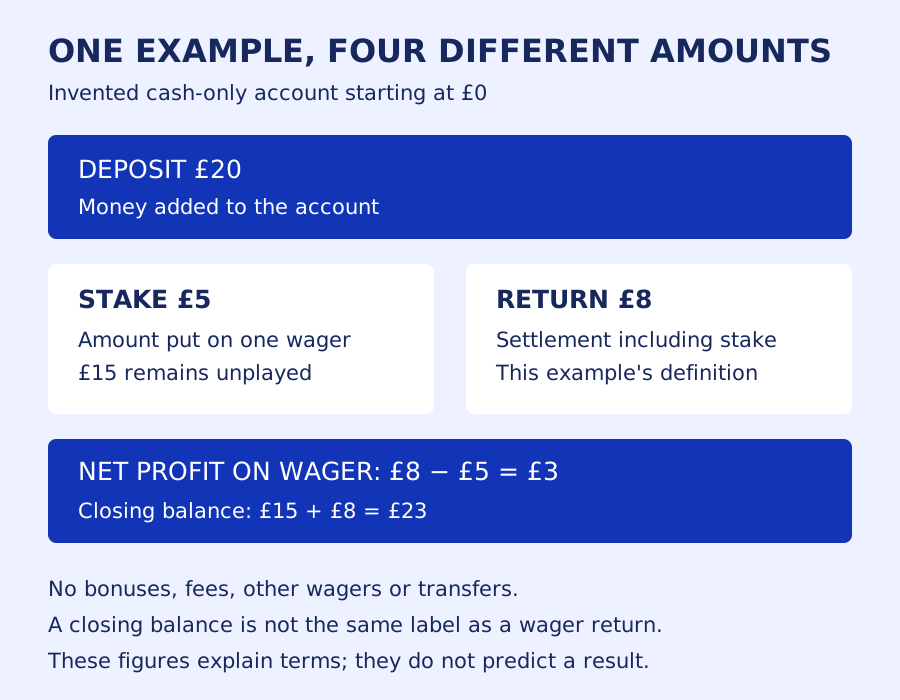
Use the diagram’s invented cash-only example. An account starts at zero, receives £20 and then places one £5 wager. The deposit is £20, the stake is £5 and £15 remains unplayed. If the wager later returns money and another wager is placed, a new stake exists even though no second deposit was made.
When reading a history, preserve the transaction type beside each figure. For a statement about money paid into an account, use deposits. For a statement about a particular wager, use that wager’s stake. Adding repeated stakes and calling the result “money deposited” changes the meaning of the record.
Return / net profit: check whether the stake is included
In the illustrated example, “return” means the settlement amount including the original stake. A £5 wager with an £8 return therefore produces £3 net profit on that wager. Add the £8 settlement to the £15 that was not wagered and the closing account balance is £23. No bonus, fee or other transaction is included.
If that same £5 wager instead returns £2, its net result is a £3 loss. A positive settlement amount does not necessarily mean profit. If it returns nothing, the wager’s net result is minus £5. These are arithmetic illustrations, not predictions about any game.
Return is not the same as profit examines this distinction on its own. Before copying a displayed “win”, check the product’s explanation of that label. Keep a wager result separate from an account balance, and keep both separate from a withdrawal. A balance includes money beyond one wager; a withdrawal is a transfer out.
RTP / session result: a percentage is not a repayment promise
Return to player, abbreviated RTP, concerns the share of stakes returned over a long run of plays under the game’s conditions. William Hill’s help article explicitly distinguishes that percentage from what an individual play or series of plays returns. This is a documented terminology example from an operator, not an assessment of its service.
For reading purposes, attach two questions to an RTP figure: which exact game rules specify it, and what quantity is in the denominator? Do not read a percentage of stakes as a guaranteed percentage of the money deposited. The deposit and stake example above explains why those bases differ.
A session result describes an observed period of play. It can be written as amounts and timestamps without calling it a measured long-run RTP. If you are reviewing a screenshot, copy the actual label rather than expanding an unexplained percentage into a performance claim. The definition helps identify information; it does not tell a reader to continue playing.
Sources: William Hill: what RTP means.
RNG / mapping: a number and its game meaning
A random number generator, or RNG, produces numbers intended to have statistical randomness. Mapping uses an RNG result to select a game outcome. Scaling converts an output into the range required by a product. These definitions distinguish related processes rather than three names for the complete game.
Imagine an educational card display showing a seven. The visible card does not tell you the numerical output that preceded it, the relevant mapping or how the implementation was checked. A description of the animation therefore answers a presentation question. It does not document the underlying random process.
An RNG is one part of a game gives a focused introduction to those stages. When collecting information, write the claim beside its evidence: a game-rules passage, provider documentation or relevant testing information. Avoid expanding a narrow statement about randomness into a claim about withdrawals, support or the accuracy of every page on a casino site. Those are separate questions requiring their own evidence.
Sources: Gambling Commission: technical standards definitions.
Provider / operator: identify the role behind the name
“Provider” commonly points to the business supplying a game or related software; “operator” points to the business providing the gambling service. Treat these as roles to investigate, rather than assuming every logo names the same counterparty. A game credit and an account-terms footer may identify different businesses.
The Gambling Commission’s software guidance separates permission to manufacture, supply, install or adapt gambling software from permission to provide gambling facilities. That distinction explains why evidence about a software business cannot simply be transferred to a casino account relationship.
An invented research note might contain three fields: displayed game title, named supplier and business identified in the account terms. Leave an unknown field blank until a source establishes it. Similar branding is not enough to fill the gap. If the question concerns an account transaction, first identify the account relationship; if it concerns a game feature, find the documentation for the exact title and version.
Demo / bonus: the word free does not settle the context
In the technical glossary, play-for-free is a demonstration without money or money’s worth staked or won. A promotional bonus is a separate offer whose conditions must be read. Do not treat a pretend demo balance as withdrawable cash or assume an offer’s “free” label means it has the same status as demonstration play.
RTS 6 addresses how same-website demonstrations represent corresponding money games. Its guidance separately discusses supplier demonstrations designed to show bonus features. Those contexts matter when interpreting a feature video or demonstration page; seeing an exciting sequence does not establish its frequency in ordinary play.
Record which of three things you are looking at: a playable demonstration, a feature showcase or an account promotion. Then read the matching explanation. This guide does not reproduce an offer or describe any named promotion’s conditions. If the page mixes those contexts without clear labels, the sensible research response is to preserve that uncertainty instead of treating them as interchangeable.
Sources: Gambling Commission: technical standards definitions; Gambling Commission: RTS 6, play-for-free games.
Game / round / session: keep the boundary attached
In ordinary interface reading, a game title identifies the product and a round identifies a unit of play under its rules. A session groups play within a defined boundary. The RTS glossary’s gaming session starts with real-money play and ends on exiting a game; a different report may use a separately documented counting method.
An invented history with five settled rounds is not automatically evidence of five sessions or five different games. It might show repeated play within one game visit. Conversely, one account login might contain visits to more than one title. Keep the recorded event and its definition together before counting it.
For a support reference, preserve the exact round identifier if the product supplies one. For an article about activity, preserve the report’s session definition. If all you have is a timestamped screenshot, describe it as that. A screenshot can document a visible state without establishing the beginning or end of a session.
Sources: Gambling Commission: technical standards definitions.
Progressive / fixed: a prize amount and a prize mechanism
A progressive jackpot accumulates contributions from stakes above a starting value. A fixed prize uses an amount or payout rule set for the stated game conditions; “fixed” need not mean the same cash sum at every stake. Neither label by itself tells you the chance of receiving the prize.
RTS 9’s jackpot guidance identifies information such as funding, eligibility and how awards are determined. Those are useful reading prompts. A large number on a banner leaves those questions unanswered, and a changing displayed value does not by itself identify a trigger rule.
Use the same method across this dictionary: retain the full phrase, identify the relevant amount or role, and find the document that defines it. The selector can remind you of a distinction, but the exact game and account documents supply the operative context. A precise reference note ends with what was established and what remains unknown, rather than turning a familiar term into an assurance.
Sources: Gambling Commission: technical standards definitions; Gambling Commission: RTS 9, progressive jackpots.
Questions answered
Is a casino deposit the same as the total amount staked?
No. A deposit adds account funds, while stakes are amounts committed to wagers. Returned money can be staked again without another deposit.
Does an £8 return on a £5 stake mean £8 profit?
If the £8 return includes the original stake, the wager’s net profit is £3. Check the meaning of the displayed label.
Does an RTP percentage predict my next session?
No. It describes a long-run return percentage under the game’s conditions, not a guaranteed result for an individual session.
Is demo credit a casino bonus I can withdraw?
Do not assume so. Demonstration balances and promotional offers have different contexts. Check the page type and the applicable terms.